Athens · Delphi · Meteora · Peloponnese
Welcome to Greece. Your private driver meets you at Athens International Airport and transfers you the 45 minutes into the city — typically to a hotel in Plaka (below the Acropolis, the most atmospheric district) or Syntagma (central, most convenient for the sites). Check in, unwind from the flight, and walk a little to shake off the time change.
Athens is a city you can see from almost anywhere — the Acropolis is visible from rooftop terraces, street corners, even the Metro platforms. Dinner tonight is your first proper Greek meal somewhere in Plaka, with a view back up at the illuminated Parthenon that is genuinely one of the world's great night images. Your specialist has the reservation ready.
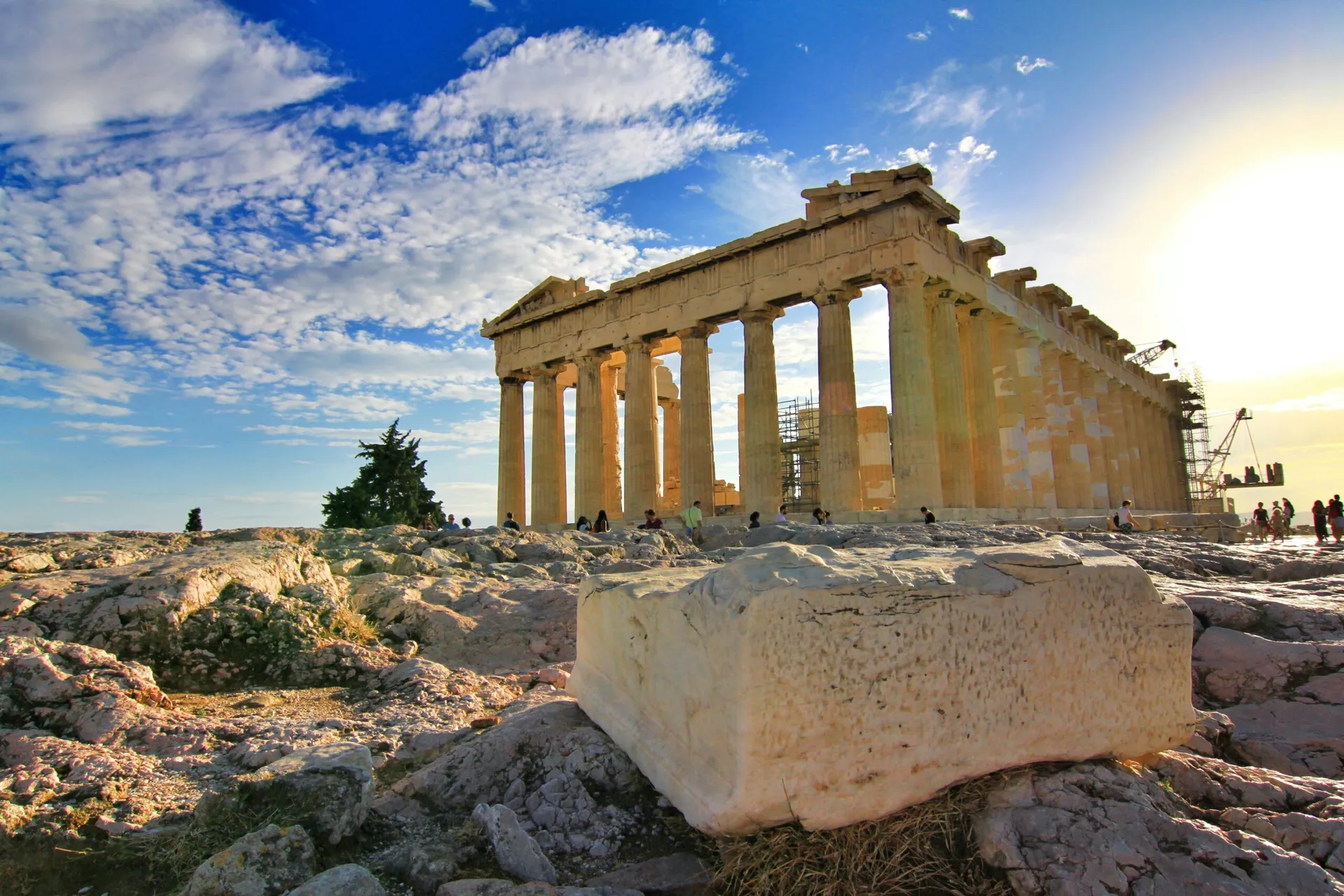
The foundational Athens day. The Acropolis is the morning's anchor — 2,500 years of continuous architecture on a limestone outcrop at the center of the city, with the Parthenon, Erechtheion, Temple of Athena Nike, and the Propylaea all on the single site. Your specialist has pre-booked the first timed entry of the morning, which is the best time both for the light on the marble and for beating the midday heat. A private licensed guide walks you through the site in roughly two hours.
From the Acropolis, a short walk downhill takes you to the New Acropolis Museum — the Bernard Tschumi building that houses the Parthenon marbles in original context. Plan 90 minutes. Afternoon: the Ancient Agora, 656 feet north of the Acropolis, where Socrates and Plato argued and the Athenian democracy that shaped the modern world was actually practiced. The Stoa of Attalos museum and the Temple of Hephaestus (the best-preserved Doric temple anywhere in the world) are both on the site. Evening: final Athens dinner before tomorrow's departure for Delphi.
The mainland archaeology tour begins. Your private driver collects you after breakfast and the route runs northwest out of Athens, through the mountain passes of Boeotia — historical battleground country (Thebes, Thermopylae a day to the north) with views that change every hour of the drive.
The scheduled stop is Osios Loukas, an 11th-century Byzantine monastery halfway to Delphi that is genuinely one of the most important surviving Byzantine buildings in Greece. The mosaic work inside the katholikon (the main church) dates from the 11th century and is on the same tier as the mosaics at Hagia Sophia. Lunch nearby, then continue to Delphi — roughly 90 minutes further on mountain roads. By mid-afternoon you arrive and check in to your Delphi hotel, which has a terrace view down the steep valley toward the Gulf of Corinth. Evening at leisure.
The morning at Delphi. The ancient Greeks considered this place the center of the world — the Oracle here, at the Temple of Apollo on the slopes of Mount Parnassus, was consulted by every major Greek city-state before any significant decision for nearly a thousand years. Your specialist has pre-booked a private-guided tour of the archaeological site: the Sacred Way up through the terraced treasuries (including the reconstructed Athenian Treasury), the Temple of Apollo itself (six columns re-erected), the theater above it, and the ancient stadium at the very top of the site where the Pythian Games were held.
The uphill walking is gradual but cumulative — roughly an hour at the site with rest points. Lunch at a taverna in modern Delphi village with the view out across the valley. Afternoon: the Delphi Archaeological Museum at the base of the site, which houses the Charioteer of Delphi — a 5th-century BC life-size bronze that is one of the most important surviving Greek sculptures in the world. The museum is excellent and genuinely worth 90 minutes. Evening at leisure in Delphi.
A long but scenic private-driver transit day — north from Delphi through central Greece to Meteora, approximately 3.5 hours with stops. The route runs past the pass at Thermopylae (the 480 BC Leonidas-and-the-300-Spartans site, with a modest modern monument and a sober weight that survives the thin tourist dressing) and through the agricultural Thessaly plains.
Meteora appears as you approach Kalambaka — a set of vertical sandstone pillars rising 1,312 feet above the plain, with Greek Orthodox monasteries perched improbably on their tops. The rock formations are natural (erosional sandstone from an ancient sea) but the sight of the first monasteries through the windshield is one of the great Greek travel moments. You check in to your hotel in Kalambaka or Kastraki (the village directly below the rocks) with a window view of the pillars. Evening at leisure.
A full day visiting the Meteora monasteries. Six of the original 24 monasteries from the 14th and 15th centuries survive as working communities — four monks' monasteries and two nuns' convents. Your private driver takes the mountain road that loops the rocks, stopping at each monastery on the itinerary.
The sample visits: Great Meteoron (the largest and oldest, founded 1344, 300 steps up), Varlaam (beside it, 195 steps, excellent 16th-century frescoes), Roussanou (smaller and more dramatic — a nuns' convent on an almost sheer pillar), and Saint Stephen's (the most accessible, linked to the plateau by a bridge, a nuns' convent with a substantial icon museum). The full four-monastery day is intense — a strong-paced version is two monasteries in depth rather than four in passing. Your specialist adjusts based on your group's pace. Evening: a final Meteora dinner with the rocks illuminated in the distance, which stays with you.
The longest driving day of the trip — approximately 5 to 5.5 hours from Meteora southwest across central Greece and into the western Peloponnese. Your private driver has this well-managed: the car is comfortable, the route passes through mountain scenery that is itself part of the experience, and your specialist has a scheduled lunch stop at one of the traditional villages on the way (Trikala, Lamia, or Patras depending on road conditions and timing).
You arrive at Olympia by late afternoon. The modern village is small, quiet, walking-distance from the archaeological site. Check in to your hotel, take a short walk down to the fence of the ancient site (you can see the ruins from the perimeter path at sunset without entering), and settle in for an unhurried evening. Tomorrow morning is when Olympia really opens up.
The morning at ancient Olympia — the sanctuary where the ancient Olympic Games were held continuously from 776 BC to 393 AD (nearly 1,200 years), and from which the modern Olympic tradition is derived. Your specialist has pre-booked a private guided tour of the site: the Temple of Zeus (where the Statue of Zeus — one of the Seven Wonders of the Ancient World — once stood), the Temple of Hera (the oldest standing temple, where the Olympic flame is still lit for every modern Games), the Bouleuterion where the athletes swore their oaths, the Palaestra wrestling school, and the stadium with its original start and finish lines. You can walk the track; that's the point.
The Olympia Archaeological Museum is next door and is genuinely world-class — the central Hermes of Praxiteles (a 4th-century BC marble often described as one of the finest Greek sculptures surviving) and the Nike of Paionios are both here. Lunch in the village, then your private driver takes you on the afternoon transfer (3 hours) across the Peloponnese to Nafplio, arriving by early evening.
The final full day and one of the densest in the itinerary. Your private driver takes you first to Mycenae, 25 minutes from Nafplio — the fortified Late Bronze Age citadel (c. 1350 BC) that Homer named in the Iliad as the seat of Agamemnon, king of kings of the Greek forces at Troy. The Lion Gate (1250 BC, still standing with the lion-relief lintel) is the entrance; the Treasury of Atreus (a 46-foot beehive tomb with a massive lintel stone of 120 tons) is a short walk away. Your specialist has arranged a private-guided tour.
Late morning: the private transfer continues to Epidaurus, 40 minutes east, where the 4th-century BC theater is the best-preserved ancient Greek theater in the world — 14,000 seats, still in use for summer performances, with acoustics so precise that a coin dropped on the orchestra is audible from the top row. Your guide will demonstrate. Lunch afterward and the return to Nafplio by mid-afternoon leaves the late afternoon and evening for Nafplio itself — Greece's first modern capital (1823), a small Venetian harbor town with three fortresses (the Palamidi above, Bourtzi in the harbor, Akronafplia on the cliff) and a walking old town that rewards an unhurried evening. Final dinner of the trip.
A final Peloponnese breakfast, then your private driver takes the 2-hour transfer across the Corinth Isthmus and up to Athens International Airport for your departure flight. The drive passes the narrow Corinth Canal (the 3.9-mile waterway cut through the isthmus between 1881 and 1893, a remarkable piece of engineering worth a 10-minute stop at the bridge if timing allows).
Ten days of mainland Greek history is dense but rewarding — most guests leave already planning a return for the islands they deliberately skipped, or for the sites they want more time at (Delphi and Meteora are the two most common 'I could have spent another day there'). Your Juniper specialist remains reachable throughout departure day, and your in-app itinerary stays accessible for any last-minute questions. Safe travels home.
This is a sample luxury custom route — a starting point, not a fixed package. Many clients travel something very close to this, customized for their travel style, group, and dates. Book a free consultation and a specialist will build from here.
Your specialist pre-arranges the right luxury experiences based on your interests and travel style. These are the custom experience types available on this route — specific choices are made with you, not for you.
Activities are selected and pre-booked with your specialist based on your interests — not all activities are included in every trip version. Availability varies by season.
You work directly with a specialist who knows Greek mainland history deeply — not a call center or booking agent. Every consultation is with someone who has walked these archaeological sites in person, knows which Meteora monastery catches the best morning light, and which Delphi hotel has the balcony view you want to wake up to.

Florence-based Southern European specialist. Lexi splits her year between Italy and the wider Mediterranean, planning custom Greece itineraries with the same firsthand depth she brings to Italy — which Cycladic island fits which travel style, which Athens neighborhood to base in, and how to weave ferries, flights, and private boats into a journey that flows.

Juniper Tours’ most tenured specialist with 25 years of experience. CMSC certified and a former Peace Corps volunteer. Taryn brings tenured detail-orientation to every Greek itinerary — she knows which Meteora monastery catches the clearest light, which archaeological site opens earliest to avoid the coach-tour crowds, and which booking needs to be made six months out or it won’t happen.
“I took the most amazing trip to Greece, and everything was handled for us from start to finish. We stayed in incredible properties, and our itinerary included hands-on cooking classes, an unforgettable wine tour, and a dreamy sunset boat cruise. All transportation was perfectly arranged, so we never had to worry about a single detail. The entire trip was seamless, stress-free, and full of unforgettable memories.”
Shawneen T. · Greece Custom Tour · Verified Google Review
30 minutes, completely free. Walk away with a clear picture of what your luxury custom Greece trip could look like — dates, route, 4 and 5-star accommodations, and all.